

Climate Justice
NARRATIVE POWER
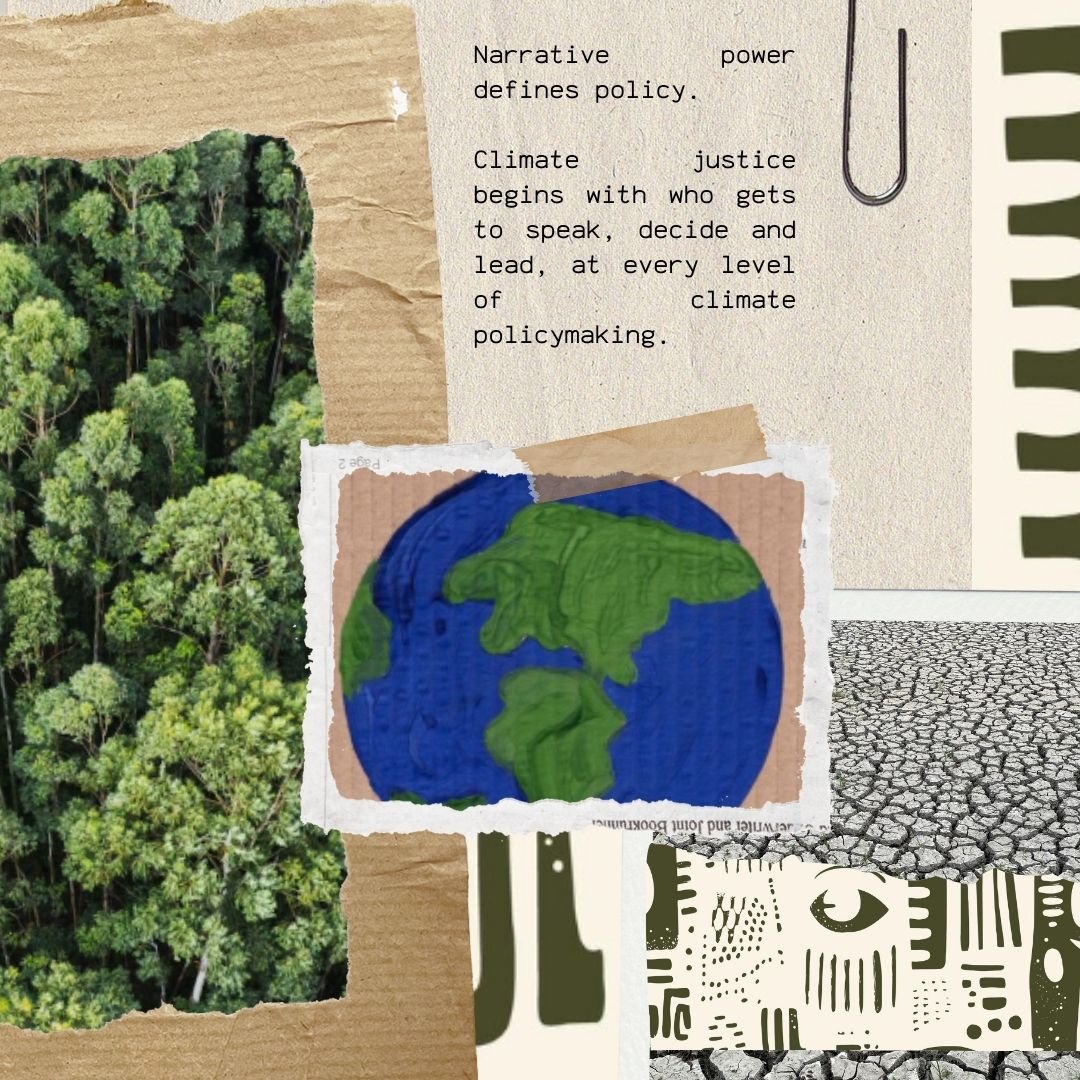
If the climate crisis is global, climate decision-making must be too.
Climate Justice as a Driver, Not a Side Note
What DO WE FOCUS ON IN OUR RESEARCH?

-
Who is in the room and who holds power?
We track who attends key climate events, who they are representing, and how leadership roles are distributed between the Global South and Global North. This helps reveal whether participation translates into meaningful influence, rather than symbolic presence.
-
Whose voices shape the story of climate action?
We monitor media coverage, online discourse, public statements, and agenda-setting language to understand which perspectives dominate and which are sidelined. Climate narratives influence policy, legitimacy, and public understanding, so we analyse who gets heard, amplified, or ignored.
-
What prevents equitable involvement in climate governance?
We document structural, financial, political, and logistical barriers such as visa restrictions, funding gaps, digital access limitations, and institutional gatekeeping. Understanding these systemic barriers is key to pushing for reforms that enable just and inclusive climate decision-making.

REPORTS
Climate justice: who has a seat at the table?
Our results showed that:
There is a clear gap in leadership between the Global North and South. At COP29, despite Global South actors making up 75% of attendees, they held less than half of leadership roles.
Inclusion must go beyond presence at climate events; it requires meaningful participation in decision-making.
Narrative power defines policy; when Global North media and voices shape the conversation, the Global South gets left behind.
Transparency is the foundation of accountability; without it disparities are obscured and become invisible.
Climate justice begins with who gets to speak, make decisions and lead, at every level of climate policymaking.

NARRATIVE POWER AND CLIMATE JUSTICE
Phase 1 of this project, Climate Justice: Who Has a Seat at the Table?, revealed critical gaps in inclusion, representation, and narrative power within global climate governance. Focusing on COP29 as a case study, our analysis showed that while Global South actors made up 75% of attendees, they held less than half of leadership roles among major organisations, therefore limiting influence on policy and decision making. Public discourse on climate justice was similarly skewed. Traditional media coverage, often dominated by Global North voices, meanwhile, barriers such as visa restrictions, funding constraints, and logistical hurdles continued to limit equitable participation, particularly for youth, grassroots, and Indigenous actors.
With COP30 approaching and climate negotiations intensifying across multiple forums there was an urgent need for systematic change. Our initial research methodology included cross-event monitoring of different climate events during 2025-2026.
Building on these findings, Phase 2 focused only COP30 as a critical moment to further examine how inclusion, narrative power, and structural barriers shape climate governance in practice. Rather than expanding across multiple events, this phase used COP30 as a focused case study to further explore how climate justice narratives are constructed, whose voices are amplified, and how participation is enabled or constrained.

RESOURCES


PROJECTS

THE WHY
The ANCJ responds to several key realities:
A gap exists in climate justice documentation and narrative leadership from African perspectives.
Climate change impacts are already disproportionately affecting vulnerable communities.
There is ever growing momentum among Africans in the climate space.
Policy and funding decisions are often disconnected from local realities.
The current moment presents an opportunity to influence global and local climate discourse.

Our Approach
The African Narrative for Climate Justice (ANCJ) is an initiative by Level the Playing Field in Development (LPFDev) that emerges from the recognition that climate narratives, decision-making processes, and solutions affecting African communities are too often shaped outside the continent. Building on the research Climate Justice: Who Has a Seat at the Table?, the ANCJ seeks to centre African voices, knowledge, and leadership in climate discourse, policy influence, and action.
The ANCJ is an African-led, community-centred platform that shifts climate narratives, strengthens mobilisation, and supports equitable climate solutions grounded in justice, gender equity, and decolonial approaches.
Ensuring that climate justice work is not done for communities, but with and by them.